
BO-Learn · Subject Knowledge
5-axis milling vs. 3-axis milling: when is which technique the right choice?
In machining, the choice between 3-axis and 5-axis milling is too often made based on what is available, not on what the part requires. The trade-off is both technical and economic—and it deserves more attention than it usually receives.
Two axes difference, fundamentally different logic
In 3-axis milling , the tool moves along three linear axes: X, Y, and Z. The workpiece is fixed. What you achieve depends on what is reachable from one direction.
With 5-axis milling, two rotation axes are added. The tool or workpiece can tilt and rotate. As a result, multiple surfaces of a part can be reached in a single clamping, with an optimal tool angle relative to the material.
That sounds like a simple upgrade. But the logic behind both techniques differs fundamentally — and that determines when to use which one.
3-axis milling is no less of a choice
For a large part of machining, 3-axis milling is the most efficient approach. Prismatic parts—housings, flanges, plates, holders—with flat faces, straight walls, and simple pockets are machined correctly and cost-effectively in two or three setups.
The machine hour rate is lower. The programming is less complex. The setup times are shorter. For larger series of less complex parts, that combination is economically decisive.
The conclusion is simple: if a part can be fully and accurately machined in a limited number of setups, and the geometry does not call for it, 3-axis is the sensible choice.
When 5-axis milling is not optional
The situations in which 5-axis milling is the only or best choice are concrete and recognizable.
Complex geometries and undercuts
When a part has surfaces or features that are inaccessible from one direction — angled walls, conical shapes, curved surfaces, parts with multiple working sides — the geometry allows no alternative. A stainless steel impeller, a mold insert with complex contours, a titanium frame for a medical device: here, 5-axis milling is not a choice but a necessity.
Tight tolerances across multiple planes
Every clamping introduces an error. With tolerances of ±0.02 mm, this is manageable. At ±0.005 mm —the kind of tolerances required in medtech, defense, or semiconductor applications—every additional clamping is one too many. One clamping, one reference system, one measurement moment: that is what 5-axis offers in this case.
Lead time as a critical factor
Fewer fixtures mean less handling, less waiting time between operations, and a shorter overall lead time. For high-mix, low-volume production, where every part is different and lead times are critical, this is a concrete advantage—especially for urgent orders.
Difficult-to-machine materials
For titanium, hardened steel, or superalloys, tool positioning is crucial. 5-axis machining allows the tool to be kept as short and rigid as possible, which minimizes vibration and improves surface quality — without additional finishing steps.
The cost price logic is less simple than it seems
The hourly rate of a 5-axis machining center is higher than that of a 3-axis machine. That is a fact. But it is not the only relevant figure.
Anyone calculating the total cost—including clamping time, handling, intermediate checks, and finishing—regularly finds that for complex parts, 5-axis clamping in a single setup works out cheaper than 3-axis clamping in four. The reason is simple: time costs money, and errors cost more.
That calculation is made too infrequently. Buyers compare machine hour rates, while the real cost driver lies in lead time and the risk of errors.
| Criterion | 3-axis | 5-axis |
|---|---|---|
| Complex geometry | Limited | ✓ Yes |
| Tolerance ≤ ±0.01 mm | Risky on multiple levels | ✓ Recommended |
| Number of clamping fixtures | Multiple | ✓ A |
| Machine hour rate | ✓ Lower | Higher |
| Total cost price (complex piece) | Often higher | ✓ Often lower |
| Lead time (complex piece) | Longer | ✓ Shorter |
Three situations from practice
A rectangular housing for machine construction, with multiple drilling patterns and milled surfaces, tolerances around ±0.05 mm: 3-axis is the right choice here. Efficient, cost-effective, fully achievable in two setups.
A stainless steel impeller for a pump, with a curved blade shape, undercuts, and tolerances up to ±0.01 mm: the geometry allows no alternative. 5-axis, simultaneously machined.
A precision holder for medical equipment, relatively simple shape but with tolerances of down to ±0.005 mm on multiple surfaces simultaneously: the requirement for tolerances, rather than complexity, drives the choice here. Single clamping, no clamping error, 5-axis milling.
The geometry, the tolerance requirement, and the context together determine the outcome. Never one factor alone.
The question that is asked too infrequently
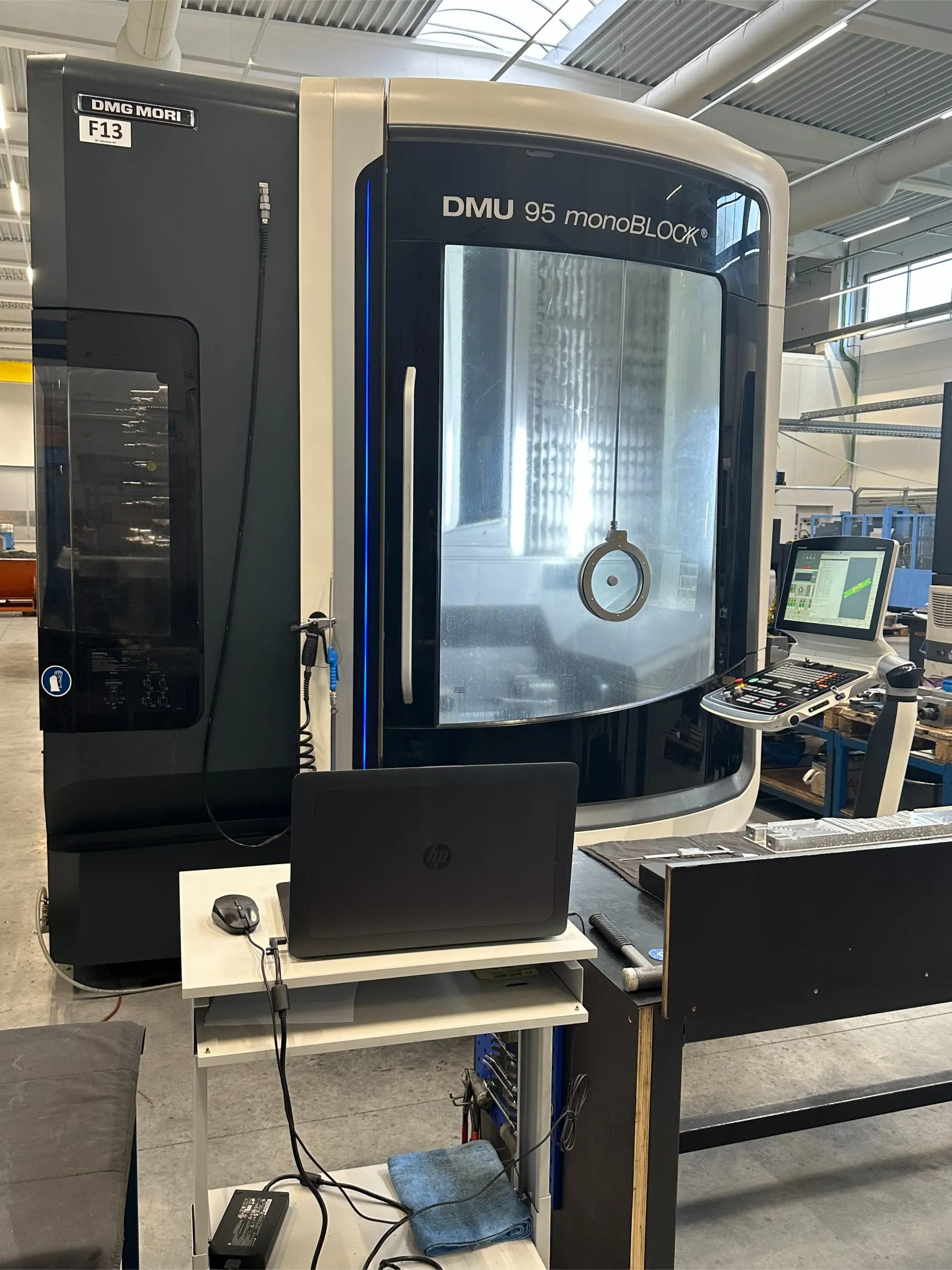
At BO-Solutions , we have 5-axis machining centers from Mazak and DMG Mori — machines capable of both simultaneous 5-axis and 3+2 positioning milling. However, the machine park does not determine the choice.
When a drawing comes in, we don't just look at whether we can make it. We look at manufacturability, tolerances, material, series, and lead time — and ask the question that buyers sometimes don't ask themselves: is this the most efficient way to produce this part?
Sometimes the answer is 5-axis. Sometimes 3-axis combined with grinding or honing. Sometimes an adjustment to the drawing that halves the lead time without sacrificing functionality.
That conversation has a name: partnership. And it starts before the quotation.
Frequently asked questions about 5-axis vs. 3-axis milling
When is 5-axis milling absolutely necessary?
When a part has surfaces or features that are inaccessible from one direction, or when the required tolerances are so tight (±0.005 mm or tighter) that any additional clamping entails an unacceptable risk of error.
Is 5-axis milling always more expensive?
The hourly machine rate is higher, but the total cost is not necessarily so. For complex parts with multiple surfaces to be machined, the total cost — including handling, clamping time, and error risk — often turns out lower for 5-axis machining in a single clamping operation than for 3-axis machining in multiple clamping operations.
Can a 5-axis machine also do 3-axis work?
Yes. A 5-axis machining center can be used as a 3-axis machine without any problems. The reverse is not possible. At BO-Solutions , we select the application based on what the part requires, not on what is available.
What is the difference between simultaneous 5-axis and 3+2 milling?
In simultaneous 5-axis milling, all five axes move at the same time — necessary for free surfaces and turbine blades. In 3+2 milling, the two rotary axes are fixed at an angle, after which the three linear axes perform the machining. 3+2 suffices for most complex parts and is easier to program. We offer both options.
How long does it take to get a quote for a 5-axis part?
For a complete drawing or a clear specification, please provide us with all the information via the contact form, and you will receive prompt, concrete feedback. We treat urgent cases as a priority.
Do you have a drawing for a complex part? Send us your specifications. We'll take a look — and tell you honestly which technique is the right one.
