
/ worn part quickly repaired, reliably reproduced
Defective part, no drawing, OEM no longer supplies?
Downtime costs money.
We ensure it doesn't come to that.
We reconstruct and reproduce your machine part – from measurement to production-ready precision part – and advise on the best approach.
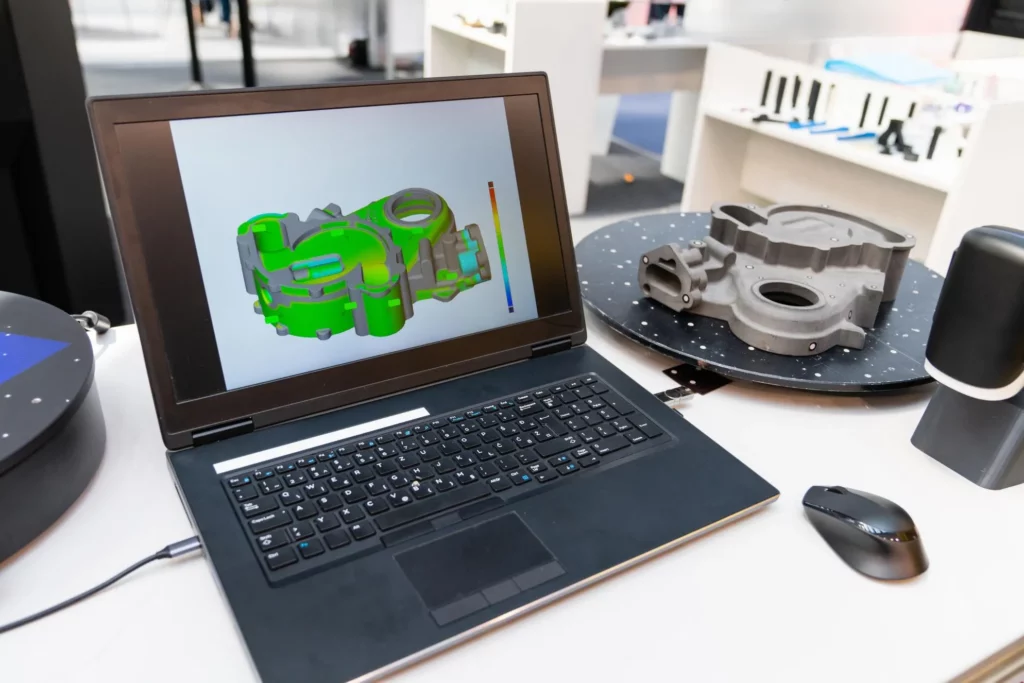
Do you have a defective or obsolete part without available drawings or a 3D model? Then your machine does not have to be written off at all.
BO-Solutions:
This way, we extend the lifespan of your machines and reduce your dependence on OEMs and long delivery times.
We turn a physical part into a fully digital and reproducible product.

Analysis & intake
We examine the damaged or worn part, its function in the machine, and the environment (load, temperature, wear, contact surfaces, …).

3D measurement to 0.005 mm
With advanced 3D measurement technology, we map dimensions, shapes, tolerances, and critical references in detail.

CAD reconstruction
Based on the measurements, we build a complete 3D CAD model, including functional surfaces, radii, fit, and reference surfaces.

Design optimization:
Where possible, we improve:

Production & final inspection
We produce the part in our own manufacturing facility and perform a final measurement, so that you receive a proven, well-fitting part.
As a reverse engineeringspecialist in Belgium BO-Solutions helps you improve existing parts, reproduce them, and extend their lifespan:
Our technical capabilities:
Obsolete or phased-out machines without OEM support.
Ideal when drawings, parts, or service are no longer available.
Defective components for which original parts are no longer available.
Perfect for discontinued or obsolete machine parts.
Retrofit and upgrade projects.
When you desire better materials, tighter tolerances, or a more durable execution than the original design.
Legacy equipment for which know-how and drawings have disappeared.
With 3D measurements and CAD reconstruction, we map every component anew.
Companies looking to reduce downtime and be less dependent on long overseas delivery times.
Local production in Flanders ensures speed, certainty, and full traceability.
Organizations looking to increase their supply security through reshoring or nearshoring:
Reverse Engineering CNC makes it possible to reproduce critical parts locally.
If a component needs to be improved or optimized
, for example through modified geometry, more precise tolerances, or better material selection.
High-mix/low-volume production where rapid reproducibility is crucial.
Reverse engineering makes repeat orders predictable, reproducible, and ISO-compliant.
When only one piece or a small series is needed.
Ideal for prototypes, test setups, and unique industrial applications.
Everything still works, except for that one part – and no one can deliver it (quickly)
Look no further, we are the partner that makes predictive maintenance profitable for every maintenance manager through the rapid production of replacement parts.

For maintenance professionals and technical services experiencing downtime due to a defective or unavailable part, we offer Reverse Engineering of mechanical components – from analysis to manufacturable replacement.
Downtime costs time, money, and focus. When every hour counts, we provide a fast, technically sound solution.
Preventive reproduction of critical parts is also possible, so that you are less dependent on delivery times and prevent unplanned downtime
Contact us:
Upload a photo, drawing, or sketch via the contact form for a quote or information.
Call +32 51 24 89 32 for technical consultation
Email your question to info@bo-solutions.be
Together, we will assess whether Reverse Engineering is the fastest and most cost-effective solution for you.
Direct contact: +32 51 24 89 32 // info@bo-solutions.be
Reverse engineering is the process of translating an existing physical part into a digital CAD design. Instead of starting with a drawing, we do the reverse: we start with the part itself, measure everything out, and reconstruct:
This creates a complete CAD model that can be reproduced, possibly with improvements. Reverse engineering is ideal when drawings no longer exist, but the part itself is still (or partially) available.
Reverse engineering is primarily used when:
Concrete applications:
With reverse engineering , you regain control over your own parts inventory and operational reliability. That is supply chain resilience in practice: less dependence on OEMs, shorter lead times during downtime, and control over your own delivery times.
A reverse engineeringproject at BO-Solutions proceeds in five steps:
Yes. For parts without extreme precision requirements, we work with photos, sketches, or dimensions that you provide yourself.
For high precision or complex geometry, the part must be physically present at our facility – you can bring it in or send it by y courier/post; after measurement, it is returned immediately. For defense and other critical applications, we always work under a strict NDA.
Reverse engineering is undoubtedly one of the most sustainable practices in the manufacturing industry. Instead of replacing an entire machine because a single part fails, you extend the lifespan of existing equipment with a single precision part. This saves raw materials, transport costs, and production volume. It aligns with circular economy principles and is increasingly included in ESG reports from industrial companies.
At BO-Solutions , this is particularly relevant: our CNC production has been carbon neutral since 2021 thanks to 880 of our own solar panels.
We solve this in various ways. In the case of partially broken parts, we reconstruct the missing parts by comparing them with intact zones or counterparts (for example, the adjacent part). In the case of heavy wear, we measure functional mating surfaces that are still usable and derive the original geometry from them. Do you have a second copy, also worn? Send us both pieces – the combination often provides a more complete picture than a single piece. reverse engineering is only difficult for completely destroyed parts without a reference – in that case, we need context (machine, counterpart, manuals).
We reproduce and replace worn, broken, or discontinued parts for industrial machinery, trains, heavy vehicles, production facilities, and technical equipment in virtually every sector.
From small precision parts to more complex composite components, in aluminum, stainless steel, steel, plastic, or exotic alloys.
For many maintenance and technical services, we are the solution when the OEM imposes (excessively) long lead times, the part is out of production, or the budget for new machines is not feasible.
Predictive maintenance (PdM) is a strategy in which sensors and data analysis predict when a component will fail, even before it actually breaks down. This allows you to replace it at the right moment instead of waiting for downtime. However, a prediction is only valuable if you also have a quick replacement plan. That is where we come in: BO-Solutions is the production partner that ensures our customer has a replacement part available within days – not weeks. Without that link, PdM is ineffective.
Predictive maintenance stands or falls with response speed. A PdM system that warns three weeks before a failure is useless if replacement via OEM channels takes eight weeks. In that case, the prediction only causes you extra stress without any benefit. A fast local production partner bridges that gap: we produce the replacement part in the time between the prediction and the expected failure. That is how you truly make the business case for your PdM investment viable.
Every sector where downtime is expensive and where specific components are located in critical machinery. Specifically: manufacturing companies with 24/7 installations (food, pharmaceuticals, chemicals), the transport sector (rail, heavy vehicles), energy and offshore (turbines, pumps, compressors), heavy industry (steel, recycling, building materials), and defense. The higher your downtime cost per hour, the faster this approach pays for itself.
Not entirely — reverse engineering and off-the-table CNC machining are related but distinct phases of the same process. Reverse engineering involves analyzing and digitally reconstructing an existing part (via 3D measurement, coordinate measurement, photo analysis, or physical measurement); off-the-table CNC machining is the subsequent production step, where we mill, turn, or machine the part without an original drawing ever existing. At BO-Solutions in Roeselare we combine both in a single process: from the first physical sample or initial sketch to a manufactured replacement part. A perfect end product.