
/ Tight tolerances, every time
BO-Solutions: precision grinding in metal for critical applications.
With face, cylindrical, and centerless grinding, we bring hardened steel, carbide, and stainless steel to tolerances of down to ±0.005 mm and Ra values < 0.1 µm – for machine building, offshore, energy, defense, and high-tech.

For bearing seats, sealing surfaces, guides, and fits, precision grinding is the only method that guarantees extreme flatness and mirror-smooth surfaces – or the difference between functioning and failure.
Applications:
We combine various grinding processes to give each part the most optimal process
Surface grinding: for smooth, flat reference surfaces
For parts that require flatness, parallelism, and a fine surface, we use surface grinding.
Ideal for guide surfaces, clamping plates, die parts, planing surfaces, and critical reference surfaces.
Cylindrical grinding: internal and external, concentric and coaxial
With cylindrical grinding, we bring shafts, bushings, and cylindrical parts to the exact size and alignment.
Perfect for bearing seats, sealing surfaces, cylindrical fits, and combinations of inner and outer diameters in a single part.
Centerless grinding: high throughput on cylindrical parts
For longer workpieces and serial parts, centerless grinding is often the best choice.
This way, you can have metal ground in series without compromising on tolerances.
A skilled metal grinder masters both machine and material.
We grind the following materials, among others:
For each component, we take into account:
Which hardness, which structure, which application? This is how we determine the right grinding strategy, wheel and parameters.
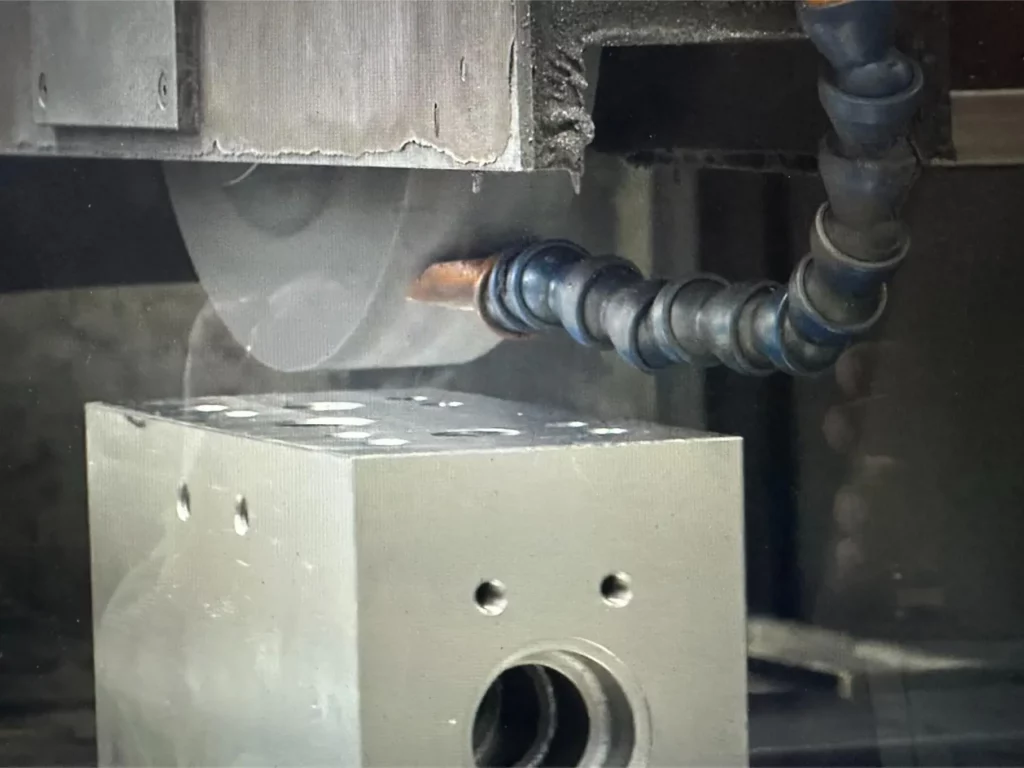
BO-Solutions specializes in industrial precision grinding for demanding applications.
Our expertise:
Need a critical part ground? We'll help you find the solution.
Do you have a component that requires high-level grinding – surface, round, or centerless?
Send us your drawing, photo, model, or existing part, and we will advise on the best grinding strategy, achievable tolerances, and combinations with other machining operations.
We grind precision parts that function in critical systems: bearing seats, sealing surfaces, hydraulic components, and mold parts. We do not regrind cutting tools.
Direct contact: +32 51 24 89 32 // info@bo-solutions.be
CNC grinding is grinding using computer-controlled grinding machines. The movements of the table, grinding wheel, and workpiece are controlled by a CNC controller.
Advantages of CNC grinding:
At BO-Solutions , we combine CNC grinding with precise measurement, so that the result not only looks good but also objectively falls within tolerance.
Broadly speaking, the difference is about:
1. Goal
2. Implementation
3. Check
A metal grinding company like BO-Solutions focuses on precision grinding: parts that must perform exactly according to drawing and within strict tolerances.