Supplier bankrupt or part no longer available? Here is how to reproduce a machine component without a drawing.
The machine is idle. The wear part you need is no longer available. The supplier is bankrupt, the manufacturer no longer supports the machine, or the technical drawing was lost years ago.
You only have the existing, worn, or defective part left.
That doesn't have to mean the end of your machine. With reverse engineering we can accurately measure an existing machine part, technically reconstruct it, and reproduce it. Even without the original drawing or 3D model, and even for a single piece.
Reproducing a machine part without a drawing: is that possible?
In most cases, yes.
In reverse engineering , we start from the physical part and its function in the machine. We analyze the geometry, functional dimensions, fits, wear, material, and surface quality.
That requires more than simply copying a part. A worn shaft, for example, has become thinner, and a bearing fit may have deformed after years of use. Naturally, you do not want to reproduce that measured wear.
We therefore look for the original functional geometry and dimensions and determine how the new part should be produced based on that.
Reverse engineering is not a stopgap measure. It is a technical process by which an existing part manufacturable and reproducible .
How does reverse engineering work at BO-Solutions?
1. Analysis and measurement
We start with the existing component and examine what function it fulfills.
Where are the critical dimensions located? Which faces, bores, and fits are functional? Where do we see wear or damage?
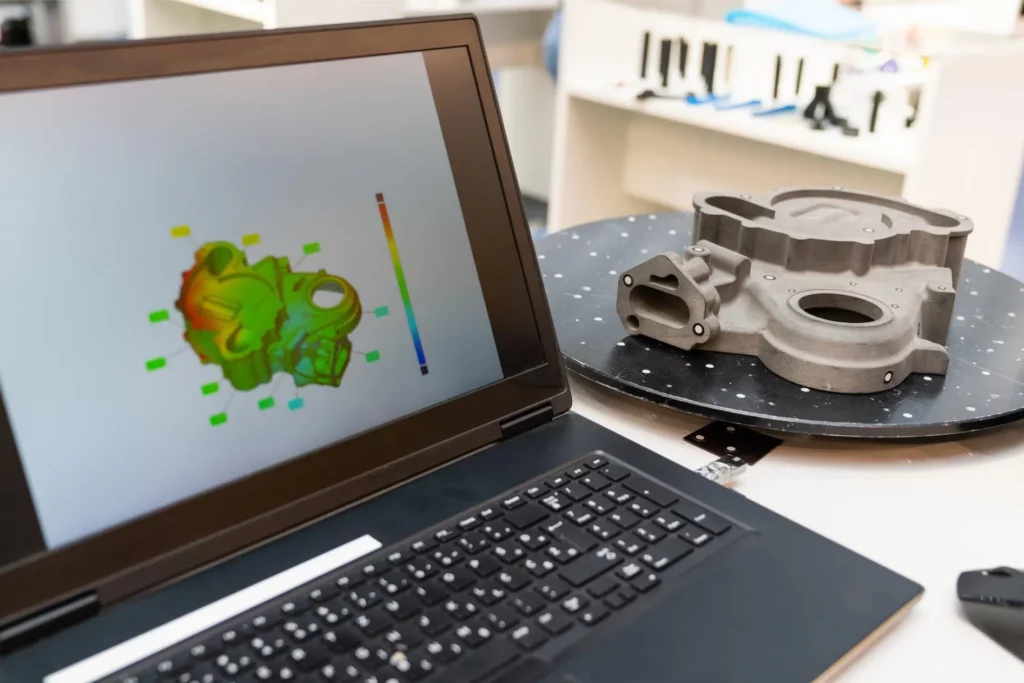
Next, we accurately measure the part. Depending on the geometry and required tolerances, we use conventional measuring instruments or a 3D coordinate measuring machine (CMM).
Wear zones are interpreted and, where possible, reconstructed to their original functional dimensions.
2. Assess material and application
A part must not only fit. It must continue to perform its function reliably.
Therefore, we also examine the material and the conditions in which the part is used. Consider load, wear, temperature, corrosion, and contact with other components.
Where necessary, we investigate whether the original material is once again the best choice or whether an alternative is technically more interesting.
3. Create a technical drawing or 3D model
Based on the measurements, we digitally reconstruct the geometry.
This creates new technical documentation that makes the part reproducible. This is immediately a significant advantage for future reorders and the management of critical spare parts.
4. Reproduce the part
BO-Solutions has various in-house processing techniques.
Depending on the part, we use, among others, CNC milling, 5-axis milling, CNC turning, surface grinding, centerless grinding, honing, lapping, welding, and keyway broaching .
We process both metals and engineering plastics.
5. Measure and check
After production, we check the critical dimensions and tolerances.
The goal is not only for a part to physically fit into the machine. It must function technically correctly within the application for which it was produced.
BO-Solutions is ISO 9001 certified.
Which machine parts can we reproduce?
Many mechanical components made of metal and plastic are suitable for reverse engineering.
Consider, for example:
- shafts and axle journals;
- rollers, chopping rollers
- bushings and bearing fits;
- gears;
- roles;
- knives;
- screws;
- conductors and guides;
- couplings;
- sliding pieces;
- housings;
- hydraulic components;
- wear parts;
- specific tooling and machine components.
Single pieces or piecework are possible.
This makes reverse engineering particularly interesting for older machines, custom-made machines, and production lines for which original spare parts are difficult or impossible to obtain.
What if the existing part is worn or damaged?
That is just a common situation.
A worn part usually cannot be replicated one-to-one. We analyze what is still reliably measurable and, where possible, reconstruct the original geometry based on function, symmetry, fits, and connecting components.
Additional information is, of course, helpful. Do you have a second copy, an old sketch, manual, photo, or partial drawing? Please include it.
For severely damaged or complex parts, we assess in advance what is technically feasible.
Can the new part be better than the original?
Absolute.
Reverse engineering also offers the opportunity to technically evaluate an existing component.
Does it always wear out in the same place? Does it always break in the same zone? Are the tolerances no longer suitable for the current application?
Then we can examine whether optimization makes sense, for example via:
- another or more wear-resistant material;
- adjusted tolerances;
- a modified fit;
- a limited geometric adjustment;
- another surface finish or treatment.
The goal is not to blindly reproduce the original, but to create a component that better suits the current application.
Reverse engineering for maintenance and technical services
For maintenance and technical services, reverse engineering is particularly interesting when a relatively small component threatens to shut down an entire installation.
For example, we receive questions such as:
“The manufacturer no longer supplies this part.”
We are investigating whether we can reconstruct the existing part and reproduce it.
“Our machine is twenty years old and the supplier no longer exists.”
The existing part can serve as the starting point for new technical documentation and production.
“We no longer have a technical drawing.”
We measure the part and rebuild the necessary geometry.
“This part is wearing out much too quickly.”
We examine whether the material, geometry, tolerances, or finish can be optimized.
“We only need one copy.”
Even a single unique precision part can BO-Solutions be produced
can reverse engineering help limit unplanned machine downtime and extend the lifespan of existing machines and production lines.
Reverse engineering for the food industry
BO-Solutions has extensive experience with reverse engineering and precision parts for machines and production lines in the food industry.
We work for, among others, industrial bakeries and bakery lines, grain processing, frozen food companies, vegetable and potato processing, meat and fish processing, dairy, beverage production, and packaging lines.
Think of chopping rollers and chopping roller parts, shafts, screws, blades, rollers, guides, gears, bushings, and other wear and machine parts that are used intensively on a daily basis.
Depending on the application, we produce parts in stainless steel, steel, aluminium, and engineering plastics, among others . Is an existing part worn out or no longer available?
Then we investigate, using reverse engineering how we can reconstruct it and reproduce it.
Also for mechanical engineering, railways, shipping, and other industries
Reverse engineering has a much broader range of applications. BO-Solutions supports companies in, among others , mechanical engineering and automation, agro and agriculture, railway and transport, shipping and marine, petrochemicals, offshore, defense, and medtech.
For older trains, buses, and trams, we reconstruct and produce mechanical parts that are no longer available as standard. This is particularly relevant for rolling stock that remains operational for decades and for which original parts or technical drawings are no longer available.
Within shipping and maritime applications, we also produce specific mechanical parts and replacement parts for ships and installations. When a part is worn or damaged, proves to be no longer available, or technical documentation is missing, we investigate through reverse engineering how we can reconstruct and reproduce it.
The application varies by sector, but the technical question is often the same:
How do we make a critical part available again when the original is no longer available or no usable production documentation exists?
That is where the power of reverse engineering combined with precision machining.
Reverse engineering from Roeselare for Belgium and Europe
BO-Solutions is based in Roeselare, West Flanders , and supports technical services, maintenance departments, machine builders, and manufacturing companies throughout Belgium and beyond.
We combine reverse engineering, precision machining, and accurate dimensional control within a single technical process.
This allows us to start from an existing component and align the various steps: analyze, measure, reconstruct, produce, and check.
For companies that want to become less dependent on outdated machinery, discontinued suppliers, or hard-to-obtain spare parts, that is an important difference.
When is reverse engineering interesting?
Reverse engineering is particularly worth investigating when:
- an original machine part is no longer available;
- the original manufacturer or supplier no longer exists;
- there is no technical drawing or CAD model available;
- the delivery time of an original spare part is problematic;
- a part regularly wears out or breaks;
- you want to technically improve an existing part;
- you only need one or a few parts;
- you want to make critical spare parts reproducible again.
Moreover, waiting until a part breaks permanently is not the best strategy.
For critical components, it can be beneficial to reverse engineering perform. This way, you have technical information at your disposal before the next machine downtime.
Frequently asked questions about reverse engineering of machine parts
Can a machine part be reproduced without a technical drawing?
Yes, in many cases that is possible. The existing part is accurately measured and technically analyzed. Based on this, a new geometry and, if necessary, a technical drawing or 3D model can be created.
What if the part is worn out?
We do not attempt to reproduce the wear. We analyze the function, remaining geometry, fits, and other available information to reconstruct the original functional dimensions as reliably as possible.
Can you produce one part?
Yes. BO-Solutions also produces one-off pieces. This is interesting for unique machine components, older installations, and critical spare parts.
What materials can you work with?
We process a wide range of metals and engineering plastics, including various types of steel, stainless steel, aluminium, and high-performance plastics. The choice of material depends on the application.
Can you also improve an existing component?
Yes, when it makes technical sense. For example, we can evaluate material, geometry, tolerances, fits, or finish. Any change is always made based on the application.
For which companies is reverse engineering interesting?
Production companies, machine builders, engineering firms, and technical or maintenance departments, in particular, use reverse engineering to make parts available again and keep existing machines operational longer.
Should I take the part to BO-Solutions ?
A physical component is usually the best basis for a complete analysis and accurate measurement. You can provide us with photos and available technical information in advance so that we can make an initial estimate.
A defective or worn machine part without a drawing?
Don't discard an older machine just because one critical part is no longer available.
Provide us with the existing part, a few clear photos, and as much information as possible about the application. We will assess what is measurable, reproducible, and technically feasible.
This is how we turn a part without a drawing back into a part with a future.
Defective part that is no longer available? Bring it with you or send us photos. We will look at what is possible together.